
Open thread: Math fact fluency
Do you test student speed and accuracy on math facts? Are you required to?


Hi there, Bell Ringers. Today we are talking about foundational math fact fluency, and I want to hear from you.
I’ve written quite a bit about the importance of knowing math facts—addition, subtraction, and multiplication tables to 10 or 12—to students’ future math learning. Cognitive scientists say memorizing math facts decreases cognitive load for students, freeing up space to learn more complex math. Teachers and parents have told me not enough time or curricular space is spent on them.
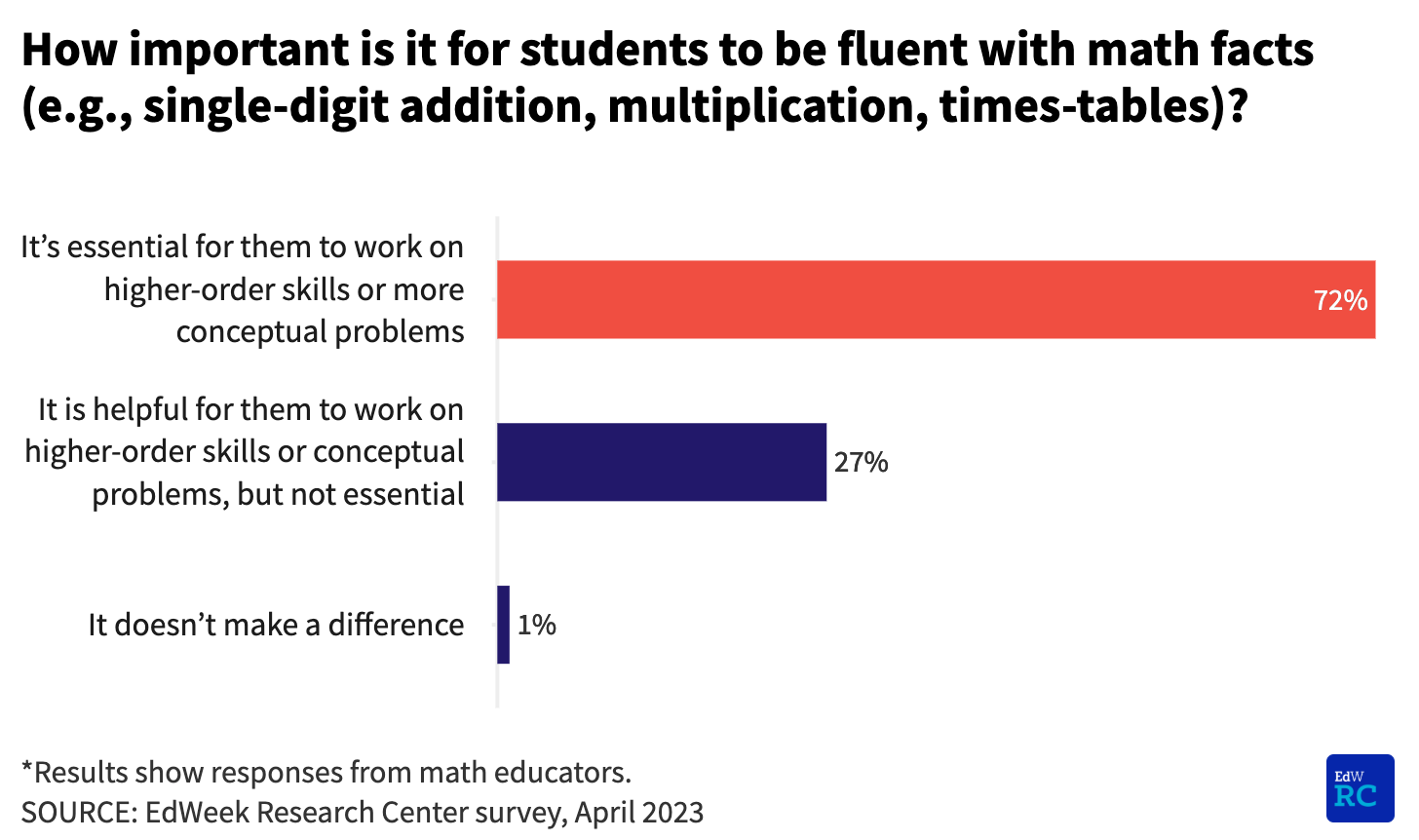
And there is some confusion over how they’re getting taught and assessed. Teachers told Education Week back in 2023 that math facts are essential to higher-order problem solving:
(Image from “What Is Math ‘Fact Fluency,’ and How Does It Develop?", by Stephen Sawchuck, May 1, 2023.)
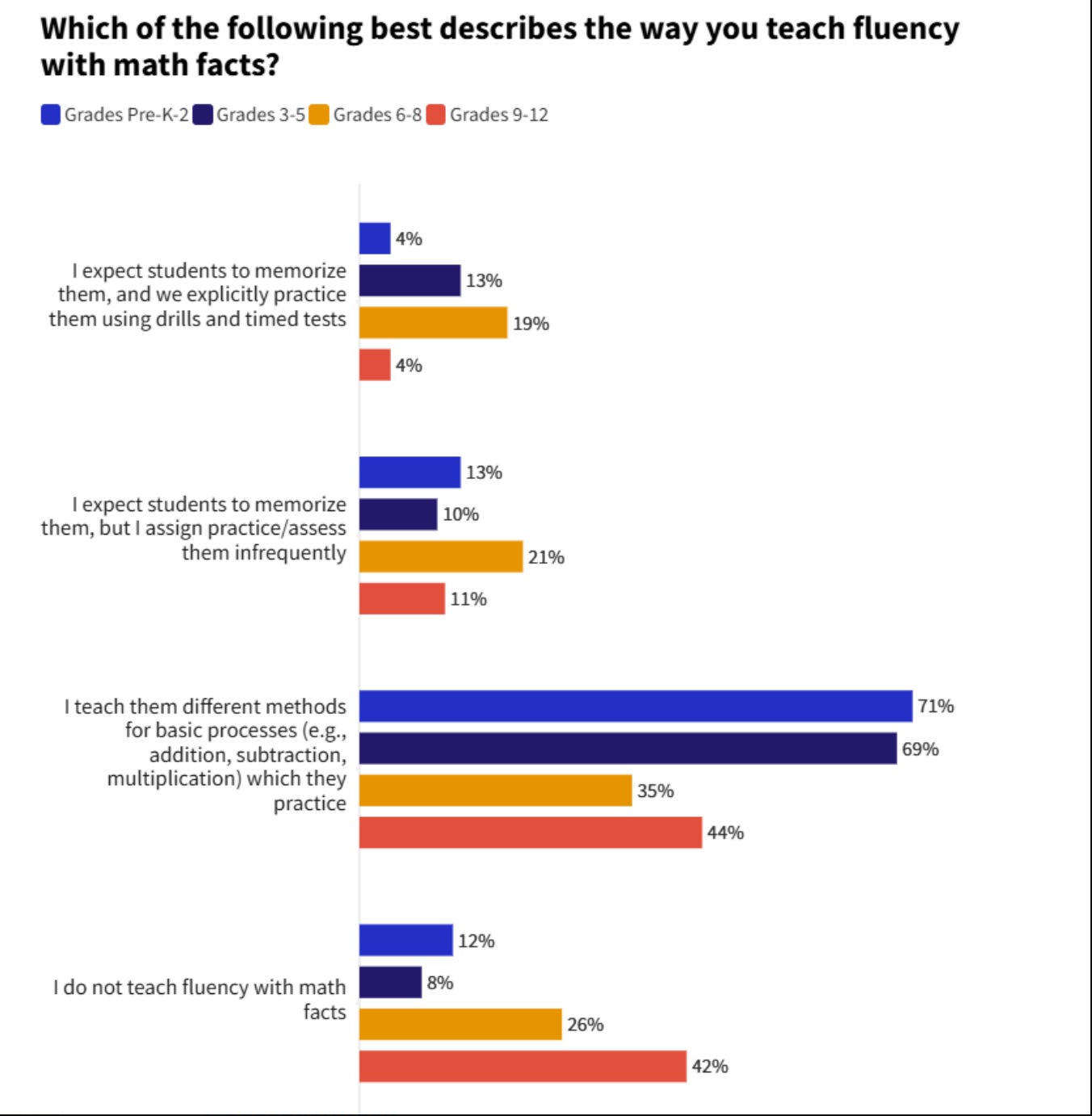
But take a look at this survey question, also from Education Week. It looks like the majority of teachers are teaching the “multiple strategies” method, and only a small percentage are asking students to memorize math facts, or assess whether they know them under time pressure.
(Image from Michael Pershan on Twitter, from an Education Week survey.)
So here’s what I want to know: do you have a school/district/state requirement to assess math facts? Or are you assessing them even though it’s not required?
In addition: Does your numeracy screener assess time and accuracy of math facts? And if students have gaps, what are the next steps?
Leave a comment or you can send me an email (put “math facts” in the subject line).
No requirement to assess fact fluency here. I don't know that I assess myself in the way you're describing because it's obvious if you just spend a few minutes with my students at the start of the year that they need more practice with math facts. I do spend a lot of time teaching and facilitating fact fluency practice in a yearlong progression with my students and do a lot of informal assessment to guide how we work through that progression - the goal is to do focused practice on all fact families, all four operations throughour the year.
I think this issue can be oversimplified. Yes, knowing math facts is crucial, but how kids get to memorization is important too. If kids are simply asked to know the answers quickly, we can miss gaps in foundational number sense. In the early grades, kids to need learn derived strategies for solving the ones they don’t know. For example, to solve 9+7, they can add 1 to 9 to make 10 and the add 6 more. This strategy comes after kids are fluent with combinations that make 10 and 10+ facts. Speed and accuracy are important, but so is flexibility. If a child forgets a fact, they need an efficient way to solve it. At first they can learn counting strategies, but then they should move on to derived strategies like the one mentioned above. I have observed students get stalled out on programs like Reflex because the program is simply assessing whether they get the right answer quickly. I watched one of my students get very fast at counting on his fingers, but the program did not teach him what to do next. Once I explicitly taught him derived strategies and had him practice, he mastered his facts in a couple months. He had been doing reflex for two years up until that point. It’s not as simple as going through flash cards. We do want memorization eventually, but we also want to build number sense. It’s like those babies that are taught to “read.” They really just memorized the whole word, but the aren’t actually reading. You can drill and drill math facts with young learners so they appear to have memorized them, but then they forget over time without foundational number sense. Math Fact Fluency by Jennifer Bay-Williams is a good resource for teachers.